

USDS is the stablecoin of the Sky Protocol ecosystem, whose price is intended to remain close to 1 US dollar. The token is used for transfers, swaps, working with DeFi applications, participating in Sky products and storing dollar value on the blockchain.
USDS appeared after MakerDAO transformed into Sky and is closely connected with DAI. At the same time, these are separate assets: users can convert DAI into USDS and back at a 1:1 ratio using the protocol’s tools.
In this article, we will explain how USDS works, what supports its price, how it differs from DAI, USDT and USDC, what sUSDS is used for and which risks should be considered. USDS and sUSDS are different tokens. USDS is used as the base stablecoin, while sUSDS represents USDS deposited into the Sky Savings Rate mechanism.
Key Takeaways
- USDS is a Sky Protocol stablecoin connected with DAI and MakerDAO, but it is not simply a “new name for DAI”.
- DAI and USDS coexist: users can convert DAI into USDS and back through the protocol’s tools, but both tokens remain separate assets.
- sUSDS is not regular USDS, but a token that represents USDS deposited into the Sky Savings Rate; its yield may change by governance decision.
- USDS should not be compared with USDT only based on growth expectations: in terms of market capitalization and liquidity, Tether remains significantly larger.
- The USDS freeze function is not an active core feature at the time of fact-checking, but the token architecture allows for the potential introduction of such a function through Sky governance in the future.
- The main risks of USDS are loss of peg, changes in governance parameters, smart contract errors, dependence on collateral, RWA risks, liquidity and limitations on the availability of certain functions.


How USDS works
USDS is issued and redeemed through Sky Protocol smart contracts. The token’s stability is supported by collateral within the system, liquidity, conversion mechanisms and governance parameters designed to help keep the USDS price close to 1 US dollar.
USDS can also be issued against collateral deposited into the protocol. If the value of the collateral falls below the required level, the position may be subject to liquidation. Collateral types, fees, limits, risk parameters and other settings are determined by Sky Protocol governance mechanisms.
The main USDS contract operates on the Ethereum network and follows the ERC-20 standard. Therefore, for a regular token transfer on this network, the user needs ETH to pay the fee.
Technical features of USDS
USDS is built on the Sky protocol, which gives it a number of technical features compared with traditional stablecoins such as USDT or USDC. Thanks to its new architecture, connection with DAI, support for the Sky Savings Rate and the development of multichain infrastructure, USDS is designed for use in DeFi, transfers, storage and products within the Sky ecosystem.
At the same time, it is important not to overstate the capabilities of USDS: it does not have the same level of mass liquidity and adoption as USDT, and some functions depend on governance decisions, the availability of specific networks, wallets and third-party platforms.
|
USDS |
Comparison with DAI | |
|
Base technology |
Sky Protocol, an ERC-20 token on Ethereum, support for Sky products and the development of multichain access through SkyLink |
DAI is the original stablecoin of the Maker/Sky protocol ecosystem, which continues to exist separately |
|
Status relative to DAI |
A separate stablecoin that can be converted from DAI and back through the protocol’s tools |
DAI does not disappear and is not automatically replaced for all users |
|
Multichain support |
Developed through SkyLink and separate deployments on supported networks and Layer 2 |
DAI is widely used on Ethereum and in wrapped or bridged versions on other networks |
|
Asset freezing |
The freeze function should not be viewed as an active core feature by default; its potential implementation is possible only through Sky governance in the future |
DAI is traditionally perceived as closer to the original decentralized stablecoin model without such a function |
|
Appeal process |
May appear only if a future freeze mechanism and related governance procedures are implemented |
For DAI, such a separate process is usually not considered a necessary part of the token model |
|
Transaction costs (Gas Fees) |
Depend on the network where USDS is used. On Ethereum, fees are paid in ETH; on Layer 2, they may be lower |
DAI also depends on the network and method of use: Ethereum, Layer 2, bridges or third-party services |
|
Transaction speed |
Depends on the selected network: Ethereum, Layer 2 or another supported deployment |
DAI has a similar dependence on the network through which the transfer is made |
|
Decentralized governance (DAO) |
The parameters of USDS, sUSDS, risks and integrations depend on Sky governance processes |
DAI is also connected with Sky/Maker governance and protocol parameters |
|
Stability of the USD peg |
The price is intended to remain close to $1 through collateral, conversion mechanisms, liquidity and governance of protocol parameters |
DAI is also designed around a soft peg to $1 and is supported by the protocol’s collateral model |
|
Network scalability |
Scalability depends not only on USDS, but also on the networks where it is available, liquidity and SkyLink infrastructure |
DAI scales through Ethereum, Layer 2, bridges, integrations and third-party DeFi protocols |
|
Protocol security |
Depends on smart contracts, governance, oracles, liquidations, collateral, integrations and the quality of risk management |
DAI has a longer history of use, but also depends on smart contracts, collateral, oracles and governance parameters |
|
Reserves and liquidity |
Collateral is not formed as a simple 1:1 reserve in USDT, USDC or BUSD, but through assets and positions approved by Sky governance, including crypto assets, stablecoins and real-world assets |
DAI is also backed by assets, deposits and protocol parameters; the collateral composition can change by governance decision |
|
Availability and wallet support |
Can be stored in EVM-compatible wallets as an ERC-20 token, but display, swaps and network support depend on the specific wallet |
DAI is supported by a larger number of wallets and DeFi applications due to its longer history of use |
|
sUSDS |
sUSDS represents USDS deposited into the Sky Savings Rate; the yield may change and is not guaranteed |
For DAI, the analogue is the Dai Savings Rate, but DAI and USDS use different mechanisms and rates may differ |
How is USDS connected with DAI?
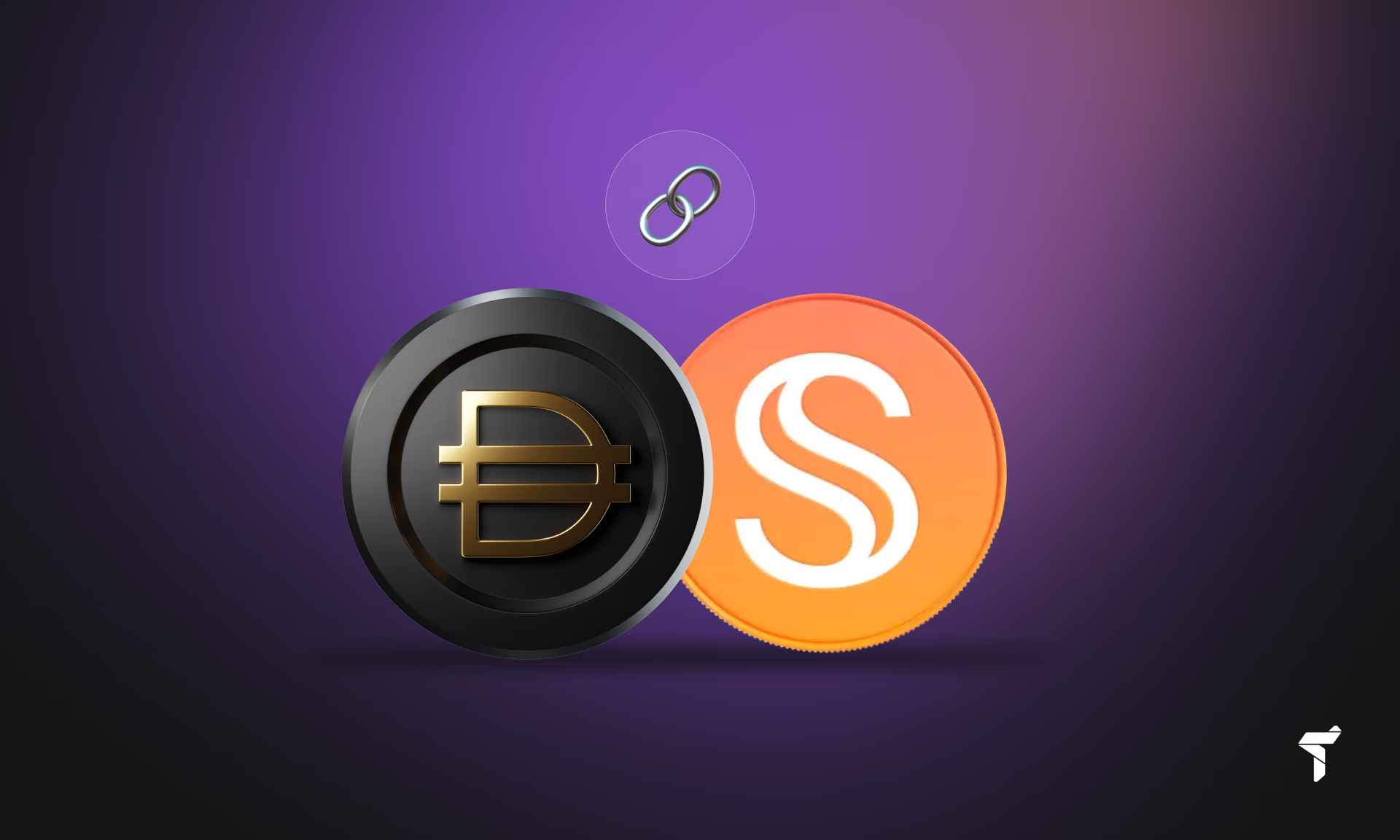
DAI and USDS belong to the same protocol ecosystem, but remain separate tokens. USDS was introduced after MakerDAO was rebranded as Sky as the ecosystem’s new stablecoin.
A special converter allows DAI to be exchanged for USDS and USDS for DAI at a 1:1 ratio. This exchange does not depend on the liquidity of a regular trading pair, but when the operation is performed on Ethereum, the user pays the standard network fee in ETH.
In practice, this means that a user can choose between DAI and USDS depending on the availability of functions, required liquidity, wallet support, DeFi service support and their attitude toward additional Sky Protocol features. For long-term use, it is important to check not only the token price, but also conversion conditions, sUSDS yield, network availability and current governance decisions.
Technical architecture and collateral mechanism of USDS and DAI
DAI is a stablecoin issued on the basis of deposits in crypto assets such as ETH or other cryptocurrencies and tokens through special contracts known as Vaults.
Every DAI issued is backed by collateral that exceeds its nominal value. For example, issuing a stablecoin may require collateral whose value is higher than the amount of debt created. Specific collateral ratios, limits and liquidation parameters depend on the type of collateral and governance decisions. This helps maintain DAI price stability and protect the system from market volatility.
USDS, in turn, keeps its connection with the base collateral model of Sky Protocol, but adds new elements:
- Conversion tools between DAI and USDS.
- Sky Savings Rate and the sUSDS token.
- The development of multichain access through SkyLink and supported networks.
- Governance parameters that can change fees, yield, limits and risk settings.
- Potential future compliance mechanisms, if they are approved by governance.
Integration example: DAI vs USDS
Imagine that a user wants to use DAI on the Polygon blockchain to make transactions or invest in DeFi platforms. In this case, they may face the need for a bridging operation, transferring tokens from Ethereum to Polygon, which involves transaction costs (Gas fees), waiting time and bridge risks.
Thanks to the development of SkyLink and multichain integrations, USDS is intended to simplify the use of Sky assets on supported networks. However, this does not mean automatic balance synchronization across all blockchains without conditions: the availability of USDS, sUSDS, liquidity, fees and functions depends on the specific network, protocol and interface.
USDS wallets

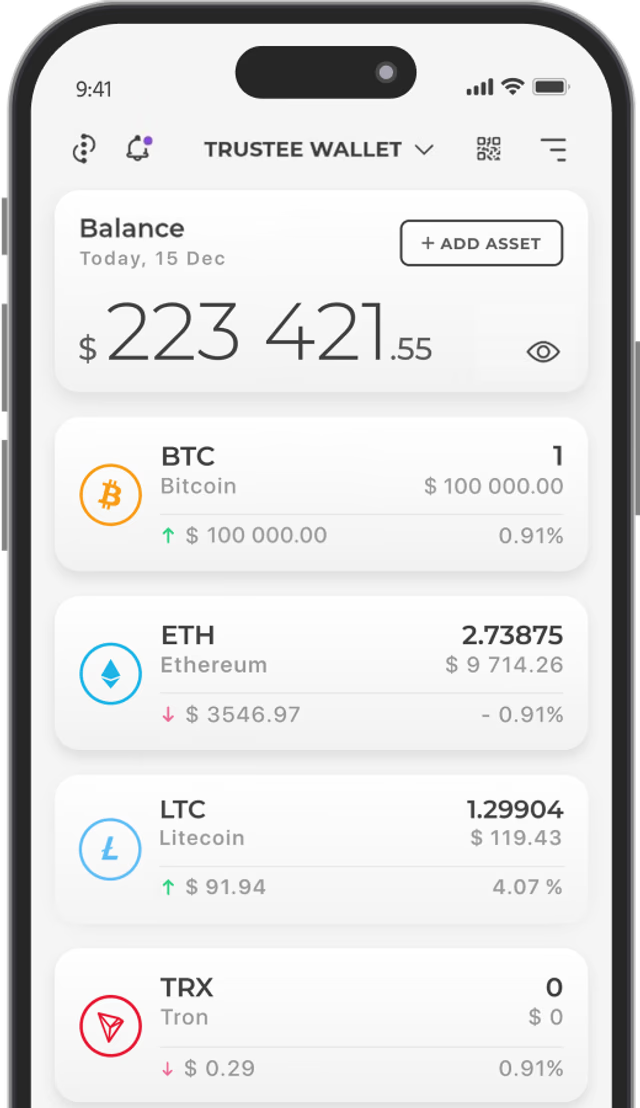
The USDS stablecoin is created based on the ERC-20 standard, which allows it to integrate with wallets that support the Ethereum blockchain and EVM networks. This means that popular crypto wallets such as Trustee Wallet, MetaMask and MyEtherWallet, as well as Ledger and Trezor hardware wallets, can be used to store or transfer USDS if the required network and correct contract address are supported.
However, actual support depends on the specific wallet. One wallet may allow USDS to be stored as an ERC-20 token but not display it automatically in the interface; another may support balance display but not have a built-in swap function. Therefore, before sending funds, it is important to make sure that the wallet supports the required network, the correct USDS contract and the chosen way of interacting with the token.
In addition, thanks to the SkyLink protocol, USDS can be used on different blockchains, providing multichain availability and the ability to work with it in wallets that support the corresponding networks, such as BNB Chain, Polygon, Base, Arbitrum, Optimism, Avalanche or other integrations, if they are available to the specific user and service.
How to buy, swap and sell USDS?
Buying, selling and swapping USDS is carried out in the same way as with other ERC-20 tokens, if the selected wallet, exchange or DeFi protocol supports USDS and the required network.
Step-by-step guide for beginners:
- First, you need to create a crypto wallet that supports ERC-20 tokens, such as MetaMask or Trustee Wallet.
- Go to the selected decentralized exchange or protocol interface and connect your crypto wallet.
- Enter USDS in the search and select this token for buying, selling or swapping. Check the token contract through official sources so you do not buy a fake.
- Enter the amount of USDS you want to buy or sell. After confirming the transaction and paying the fee (Gas fee), the swap will be completed.
- Confirm the transaction in your wallet, and after a few minutes of waiting, USDS will appear in your balance if the network is not congested and the token is displayed correctly in the interface.
USDS can also be obtained by converting DAI into USDS in supported Sky Protocol interfaces or through third-party DeFi protocols and exchanges, if they support this asset. Before making a trade, always check liquidity, fees, slippage, network, contract address and restrictions for your region or service.
What are sUSDS and the Sky Savings Rate?
sUSDS is a token connected with the Sky Savings Rate. When a user deposits USDS into the corresponding mechanism, they receive sUSDS, which reflects their share in the savings contract. It is not a separate dollar stablecoin for regular transfers, but a tokenized representation of USDS placed in the savings mechanism.
Before using sUSDS, it is important to understand that the yield may decrease, become zero or change over time. It is also necessary to consider smart contract risks, interface availability, sUSDS liquidity, tax consequences and possible restrictions for certain categories of users.
Risks of USDS
Like any stablecoin, USDS is not a completely risk-free asset. Its price is intended to remain close to $1, but under stressed market conditions, liquidity problems, oracle errors, smart contract failures or unsuccessful governance decisions, a temporary loss of peg is possible.
- Loss of peg risk. The USDS price may deviate from $1, especially during sharp market moves or liquidity problems.
- Governance risk. Protocol parameters, yield, limits and future functions depend on Sky governance decisions.
- Smart contract risk. Code errors, vulnerabilities or incorrect integrations may lead to losses.
- Collateral risk. The collateral composition may include different assets, including cryptocurrencies, stablecoins and real-world assets, each of which has its own risks.
- Liquidity risk. USDS may be less liquid than USDT or USDC, especially on individual exchanges and in some networks.
- Future change risk. Potential functions such as asset freezing or new compliance procedures may change how users perceive USDS.
Prospects for USDS
Thanks to its connection with the Sky ecosystem, compatibility with DAI, the ability to participate in the Sky Savings Rate and the development of multichain integrations, USDS has the potential to increase its role among DeFi stablecoins.
However, claiming that USDS could surpass Tether in the near future would be incorrect: USDT remains the largest stablecoin by market capitalization, liquidity, exchange support and use in transfers. A more realistic scenario for USDS is growth within DeFi, increased use in Sky products, the development of Layer 2 integrations and the gradual expansion of support in wallets and protocols.
Conclusion
USDS is an important stablecoin of the Sky Protocol ecosystem that develops the ideas behind DAI, but remains a separate asset with its own opportunities and risks. It can be used for transfers, swaps, DeFi operations, conversion with DAI and participation in the Sky Savings Rate through sUSDS.
The main advantage of USDS is its connection with Sky’s protocol infrastructure, conversion mechanisms, DeFi integrations and developing multichain ecosystem. The main limitation is its dependence on governance, collateral, liquidity, smart contracts and how widely the token will be supported by wallets, exchanges and users.
FAQ
What is USDS in simple terms?
USDS is the stablecoin of the Sky Protocol ecosystem, designed to keep its price around $1. It is connected with DAI but is a separate token. USDS is used for transfers, swaps, DeFi operations, storing dollar value and participating in Sky products.
How is USDS different from DAI?
DAI and USDS belong to the same protocol ecosystem, but remain different assets. DAI is the older Maker/Sky stablecoin, while USDS appeared after MakerDAO transformed into Sky. Users can convert DAI into USDS and back through the protocol’s tools, but USDS should not be considered a simple renaming of DAI.
What is sUSDS?
sUSDS is a token that represents USDS deposited into the Sky Savings Rate mechanism. It is used to participate in Sky’s savings mechanism, where the yield may change. sUSDS is not the same token as USDS, and before using it, liquidity, yield and smart contract risks should be considered.
Can USDS be stored in a regular crypto wallet?
Yes, USDS can be stored in wallets that support Ethereum and EVM networks, if the wallet supports the required network and allows an ERC-20 token to be added. However, balance display, built-in swaps and multichain support depend on the specific wallet, so before sending funds you should check the token contract and network.
Can USDS lose its dollar peg?
Yes, this risk exists for any stablecoin. USDS is intended to maintain a price near $1, but in the event of problems with liquidity, collateral, oracles, smart contracts, governance or severe market stress, the price may temporarily deviate from the dollar.
Can USDS replace USDT or USDC?
USDS may grow in DeFi and the Sky ecosystem, but as of 2026 it is still significantly behind USDT and USDC in liquidity, distribution and exchange support. Therefore, it is more accurate to view USDS as an alternative protocol-based stablecoin, not as a direct replacement for the largest centralized stablecoins.