



A private key and a seed phrase are often perceived as two versions of the same thing. In reality, they are different things that serve different purposes. In everyday wallet use, most people never even see a private key as a separate object — they write down the seed phrase once when creating the wallet and then rarely think about it again.
So which one is actually the “key” to a crypto wallet? And why do you need those mysterious twelve or twenty-four words at all? Below, we will examine both concepts separately, look at how they are technically connected, and determine what should be backed up first.
Key Takeaways
- A private key and a seed phrase are not the same thing, even though they are constantly confused in conversation, including by people with some experience in cryptocurrency.
- A private key is a specific secret number used to sign transactions for a particular key or address.
- A seed phrase is a mnemonic sequence of words from which a modern HD wallet deterministically derives multiple private keys.
- For a typical self-custody HD wallet, the seed phrase is the primary backup secret, although there are exceptions — manually imported keys, multisig wallets, and smart contract wallets.
- Compromise of either secret is dangerous, but exposure of a seed phrase can potentially provide access to the entire wallet rather than just one key.


What Is a Private Key?

A private key is a secret cryptographic number. It allows a user to create a digital signature for a transaction and prove the right to control specific cryptocurrency funds. In simple terms, whoever controls the private key effectively controls the funds associated with it. This is not an exaggeration or a figure of speech — it is literally how public-key cryptography, which underpins most blockchains, works.
This leads to the most important rule that almost everyone who has ever opened a crypto wallet has probably heard: you must never share your private key with anyone. Not with customer support, not with a “project partner,” and not even with a close friend who claims they simply want to “check the balance.”
There is an important caveat here: in different blockchains, an address is not always a direct representation of the public key — it is often a hash of the public key or the result of additional transformations. In other words, the chain “private key → public key → address” is correct as a general model, but the details vary from one network to another.
What Does a Private Key Look Like?
The format of a private key depends on the network and the specific wallet, so there is no universal “standard appearance.” For networks based on secp256k1 elliptic-curve cryptography — Bitcoin and Ethereum, for example — a private key is a 256-bit value and is most commonly displayed as a string of 64 hexadecimal characters.
To illustrate the idea, here is a schematic example — this is not a functional private key, but a fictional string used only to demonstrate the format:
4f0a9c1e7b2d5f80a6c4e912b7d3a9f108c2e6b9a4d7f102e5c8b3a9f6d0e214
What Is a Seed Phrase?
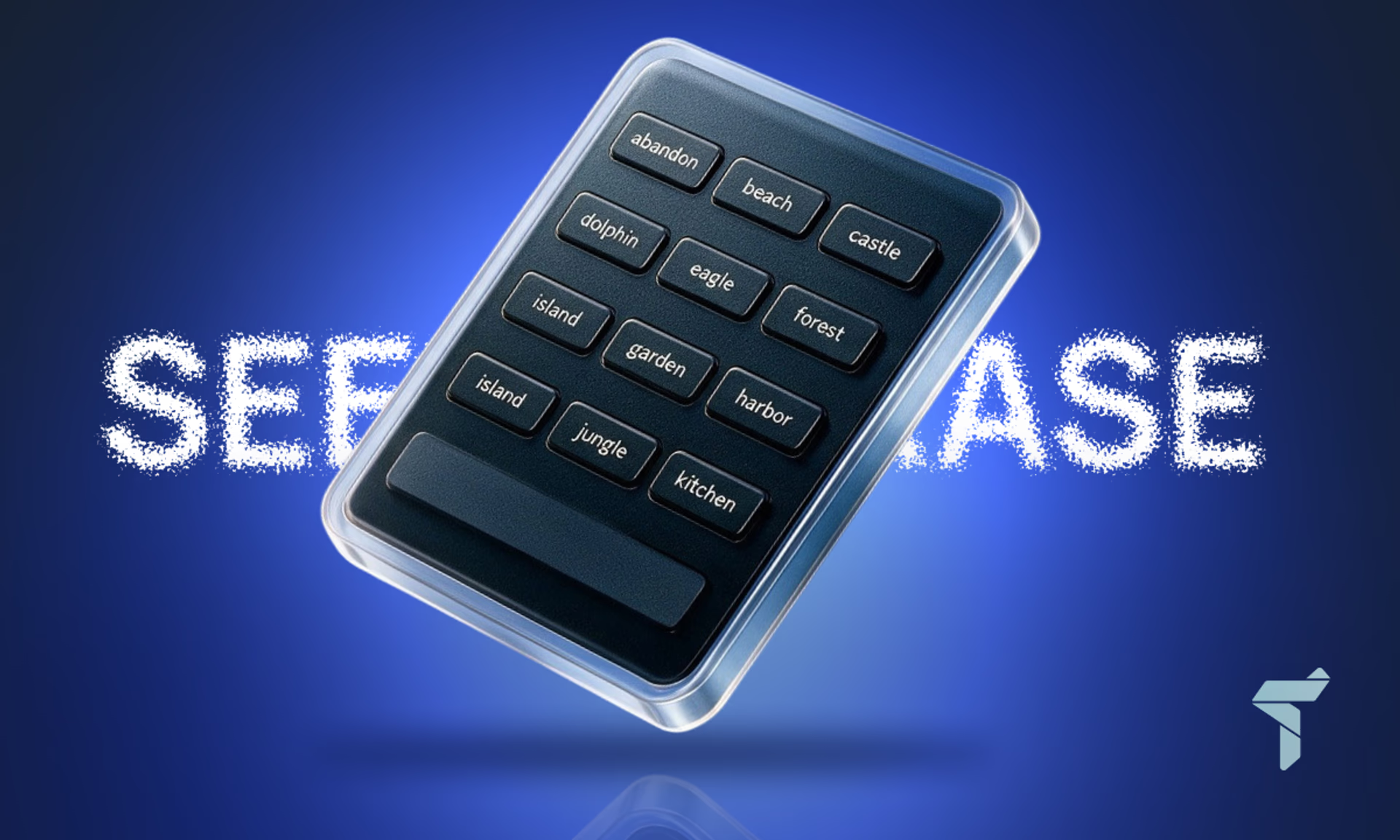
A seed phrase is a sequence of ordinary words that a wallet displays to the user when creating a new self-custody wallet. In different resources, it may also be called a recovery phrase, mnemonic phrase, or wallet recovery phrase — these terms are essentially synonymous, although a specific wallet may use its own wording in the interface.
The most common versions users encounter contain 12 or 24 words. However, these are not the only possible lengths: the BIP-39 standard, which we will discuss below, also supports other valid mnemonic lengths. Therefore, if your wallet once displayed a phrase containing a different number of words, it does not necessarily mean that something is wrong or unusual.
BIP-39
BIP-39 (Bitcoin Improvement Proposal 39) is a standard that describes how a mnemonic phrase with a checksum is created from random entropy. That mnemonic is then mathematically converted into a seed — the underlying numerical value. Based on that seed, a typical HD wallet (Hierarchical Deterministic Wallet) uses deterministic derivation mechanisms to generate a master key and, when necessary, a virtually unlimited number of child keys.
However, it is not a mandatory rule for every wallet or blockchain. Some implementations use their own key-generation and recovery logic, which is worth keeping in mind, especially when working with less common networks or specialized wallets.
Private Key vs Seed Phrase: Key Differences
|
Parameter |
Private Key |
Seed Phrase |
|
What it is |
A secret cryptographic key |
A mnemonic phrase used to create or recover a wallet seed |
|
Format |
Usually a machine-oriented number or encoded string |
A set of ordinary words |
|
Scope of access |
Usually associated with a specific key or address |
Can recover multiple keys and addresses in an HD wallet |
|
Primary function |
Signing transactions |
Recovering and reconstructing the wallet structure |
|
Human readability |
Low |
High |
|
What happens if it is exposed |
Funds controlled by that key are at risk |
Potentially the entire wallet created from that seed phrase is at risk |
|
Use for recovery |
Can restore access to a specific key or address |
Usually restores the entire compatible HD wallet |
If everything is reduced to one key idea, it is this: a private key controls a specific unit of access, while a seed phrase controls the entire wallet structure.
How Private Keys and Seed Phrases Work Together
The easiest way to understand the relationship is through the structure of a typical HD wallet:
This structure is called a Hierarchical Deterministic Wallet, or simply an HD wallet. The idea is that a single seed phrase deterministically — meaning consistently according to a fixed algorithm — generates an entire tree of keys rather than just one individual key.
- One wallet can contain many addresses — not just one, but dozens or even hundreds, depending on how actively it is used.
- Each address generally corresponds to a separate private key derived from the same seed phrase according to a defined algorithm.
- The user does not need to manually write down every individual private key if they have securely stored the correct recovery phrase and know all the parameters required for recovery.
- Conversely, a single private key usually cannot restore all the other keys in the wallet — it does not “know” about the rest of the key tree.
There is another nuance that is often overlooked: recovery compatibility between different wallets depends on more than whether both support BIP-39. The derivation path, the specific network, and the implementation details of the wallet itself also matter.
What Should You Back Up: a Private Key or a Seed Phrase?
For a typical modern HD self-custody wallet, the primary backup secret is the seed phrase (recovery phrase) — it allows multiple related keys and addresses to be restored from a single backup. This practical rule applies to most popular wallets, including those that work with Bitcoin, Ethereum, and other EVM-compatible networks.
However, it is important to avoid absolute statements such as “the seed phrase is always enough,” because there are exceptions, and you should be aware of them:
- Private keys that you manually imported into a wallet may not be derived from your seed phrase — in that case, they require a separate backup.
- Some wallets use their own non-standard backup mechanisms that differ from the classic BIP-39 model.
- Some recovery schemes use an additional passphrase — sometimes referred to as a “25th word” — and without it, the seed phrase alone will restore a different wallet from the one you expect.
- Multisig wallets with multiple signers use a completely different backup model — recovery may require a combination of keys belonging to several participants rather than a single phrase.
- Smart contract wallets may use their own access-recovery mechanisms that differ from the traditional private-key and seed-phrase model.
How to Store a Seed Phrase and Private Keys Safely
The rules are simple in theory, but failing to follow them is often a cause of lost funds. Here are the basic security practices worth following:
- Keep your backup offline — avoid digital copies that could potentially become accessible online.
- Write your seed phrase down physically, by hand, and keep the record in a secure, protected location.
- For long-term storage, consider a metal backup — unlike paper, it can be more resistant to fire, water, and deterioration over time.
- Do not photograph your seed phrase — the image may automatically be uploaded to a cloud backup.
- Do not store it in cloud notes, Google Drive, iCloud, or similar services.
- Do not send your seed phrase even to yourself via email, Telegram, Discord, or any other messaging service.
- Do not enter it on websites reached through links in emails, SMS messages, or social media messages.
- Do not share it with “support” representatives — even if the request appears official.
- Verify that your backup is correct before transferring significant amounts of cryptocurrency to the wallet.
- If you use a hardware wallet, enter the recovery phrase only through the secure recovery process specified by the device manufacturer.
Another important point: you should never publish real private keys or seed phrases, even “as an example” or “to show what they look like” — there are plenty of bots online that instantly scan such publications and withdraw funds from any associated address where assets are found.
This is also why many users who do not want to manage private-key and seed-phrase backups themselves choose custodial solutions such as Trustee Plus — in that model, the service takes responsibility for key storage while the user works with a familiar wallet and card interface. It represents a different balance between control and convenience, and each user makes that choice independently.
Conclusion
A private key and a seed phrase are not the same thing, and confusing them can be dangerous in practical terms, not merely from a terminology standpoint. A private key controls a specific cryptographic key or address. The seed phrase of a typical HD wallet has a broader role: it can restore multiple private keys at once from a single backup.
Compromise of either of these secrets can put your funds at risk. However, exposure of a seed phrase generally threatens the entire wallet rather than just one address. It should therefore be treated accordingly — as one of the most important secrets you have in the crypto world.
FAQ
Are a Seed Phrase and a Recovery Phrase the Same Thing?
Yes. In most user-facing materials, these terms are used synonymously. You may also see the term mnemonic phrase. However, specific terminology depends on the wallet — developers do not always use exactly the same wording.
Is a Seed Phrase the Same as a Private Key?
No. A private key is directly used in cryptographic operations associated with a specific key. A seed phrase, by contrast, is used to recreate the seed from which an HD wallet deterministically generates multiple private keys.
Can You Recover a Wallet With a Private Key?
A private key can be used to import or restore control over the corresponding address or account in a compatible wallet. However, a single private key usually cannot restore all the other addresses in an HD wallet — it does not contain information about the rest of the key tree.
What Happens if You Lose Your Seed Phrase?
There are two possible scenarios. If the wallet is still accessible — for example, you are still logged in on the device — you may be able to create a new backup or transfer the assets to a new wallet with a new seed phrase. However, if the device or app is lost and no other backup exists, recovering the funds will most likely become impossible. There is no service or technical method that can “recover” an unknown seed phrase.
How Should You Store a Seed Phrase Safely?
In short: offline, in a physically secure location, without photographs or cloud storage, preferably using a metal backup where appropriate, and never shared with third parties under any circumstances. See the relevant section above for more details.
How Many Words Are in a Seed Phrase?
The most common options encountered in practice are 12 and 24 words. However, the BIP-39 standard supports mnemonics of other lengths as well: 12, 15, 18, 21, or 24 words. At the same time, not every recovery phrase displayed by a wallet necessarily follows BIP-39 — other implementations also exist.
Can Someone Steal Cryptocurrency if They Know Your Seed Phrase?
Yes. If an attacker obtains a valid seed phrase for a standard self-custody wallet along with all the information required for recovery, they can recreate the private keys and gain the ability to transfer the associated funds. A blockchain does not distinguish between the legitimate owner and an attacker: a transaction correctly signed with the corresponding key is treated by the network as authorized — full stop. If a seed phrase has been exposed, it should be considered compromised. In practice, the safe approach is to create a new wallet with a new seed phrase and transfer the assets there as quickly as possible.