



The question of whether to use a hot wallet or a cold wallet sooner or later comes up for anyone who holds cryptocurrency for more than a couple of months. The way private keys are stored is, essentially, what “crypto security” really comes down to — something everyone talks about, but few explain in practical terms.
Both approaches exist for a reason — each serves a different purpose: a hot wallet is designed for active use, while a cold wallet is designed for secure, long-term storage. Below, we will explain how they differ, what risks each option involves, and how to choose the right solution for your own cryptocurrency use case.
Key Takeaways
- Hot and cold wallets differ not in where cryptocurrency is “stored” — crypto is not actually stored inside a wallet at all; it exists as records on the blockchain — but in how private keys are stored and used.
- A hot wallet is connected to the internet regularly or continuously: it is convenient and fast, but has a broader attack surface for remote attacks.
- A cold wallet isolates private keys from the network: the risk of remote theft is lower, but it has its own vulnerabilities — device loss, failed backups, and unauthorized physical access.
- A hardware wallet is one type of cold storage, not a synonym for cold storage itself.
- A practical approach for most users is to combine the two: keep a small amount in a hot wallet for regular transactions and the majority of funds in cold storage.


What Is a Hot Wallet?

A hot wallet is a crypto wallet that operates on a device with internet access, such as a smartphone, laptop, or browser. It provides quick access to assets and therefore remains the main tool for regular transfers, DeFi, NFTs, Web3, and interactions with decentralized applications. If you suddenly decide to swap a token at two in the morning, you can open a mobile app on your smartphone and do it within a minute. With a cold wallet, it usually will not be that fast — and that is perfectly normal because it serves a different purpose.
Hot crypto wallets come in several different formats:
- mobile wallets — apps installed on smartphones;
- desktop wallets — software installed on computers;
- browser wallets — extensions such as MetaMask;
- web wallets — accessed through a website without installing an application.
Popular examples of software wallets often include MetaMask, Trust Wallet, and similar solutions. In a non-custodial hot wallet, the user controls the private keys and recovery phrase — the service itself does not have access to them.
On a centralized exchange, the platform itself usually controls the private keys, while the user effectively operates through an account, much like with a traditional bank.
A non-custodial wallet works differently: the keys and responsibility for them are entirely in the user’s hands. Therefore, the fact that a wallet has internet access does not automatically mean that the user has full control over the private keys — everything depends on the type of solution.
How Does a Hot Wallet Work?
In simplified terms, it works like this: the wallet generates or imports private keys, the user creates a transaction, the transaction is signed with the private key directly on the device, and the signed transaction is then sent to the blockchain over the internet.
This permanent or regular internet connection is the main source of risk. It creates additional attack vectors:
- phishing;
- malware;
- compromised browser extensions;
- operating system compromise;
- recipient address substitution;
- social engineering.
None of these attack vectors is unique to cryptocurrency — they are standard cybersecurity threats. The difference is that in crypto, the cost of a mistake is often higher, while reversing a transaction is usually impossible.
What Is a Cold Wallet?
A cold wallet is a solution in which private keys are stored or used in an environment isolated from continuous internet access. This is where the term “cold storage” comes from. This approach is usually chosen for long-term cryptocurrency storage — funds that are not intended to be used every day. Its main advantage is a reduced surface for remote attacks: if a private key is not constantly exposed to an online environment, stealing it remotely becomes significantly more difficult.
Cold storage can take several forms:
- a hardware wallet — a separate physical device;
- an isolated offline device that is never connected to a network;
- a device with no direct network connectivity at all;
- a paper wallet — a historical and rather specific method that is rarely used today.
It is worth making an important distinction here: a cold wallet and a hardware wallet are not synonyms, although the terms are often used interchangeably. A hardware wallet is one of the most common ways to implement cold storage, but it is far from the only one.
How Does a Cold Wallet Work?
The general logic is straightforward: the private key is stored in an isolated environment → a transaction is created → the transaction is signed → the signed transaction is sent to the blockchain.
There is also a common myth worth addressing immediately: “a hardware wallet never connects to the internet.”
That is not entirely accurate.
A hardware wallet may interact with a computer or smartphone via cable, Bluetooth, or QR codes — the key point is that, when implemented correctly, the private key should never leave the secure environment of the device itself. The difference is not whether the device connects to something, but whether the private key ever leaves the isolated chip.
Hot Wallet vs Cold Wallet: Key Differences
|
Parameter |
Hot Wallet |
Cold Wallet |
|
Connectivity |
Runs on a device with regular internet access |
Private keys are isolated from continuous online access |
|
Convenience |
High |
Lower |
|
Access speed |
High |
Usually lower |
|
Protection against remote attacks |
Lower due to a larger attack surface |
Higher when implemented correctly |
|
Cost |
Often free |
A hardware wallet requires purchasing a device |
|
Primary use case |
Everyday transactions, DeFi, NFTs, Web3 |
Long-term storage |
|
Main risks |
Phishing, malware, device compromise |
Device loss, backup compromise, user error |
|
Access to funds |
Fast |
Usually requires additional steps |
|
Control over private keys |
Depends on the type of wallet |
Usually involves direct user control |
If everything is reduced to one key idea, the main difference is not where cryptocurrency physically “sits,” but how private keys are stored and used. A hot wallet keeps them ready for use — which is both an advantage and a disadvantage. A cold wallet isolates them, sacrificing speed in exchange for a smaller attack surface.
It is also worth repeating something that even experienced users sometimes forget: cryptocurrency is not literally stored “inside a wallet.” Information about balances and transactions is recorded on the blockchain, while a wallet is essentially a set of keys that allows the owner to control their assets. Losing a wallet and losing access to funds are not always the same thing if a backup exists.
Hot Wallet vs Cold Wallet Security Comparison
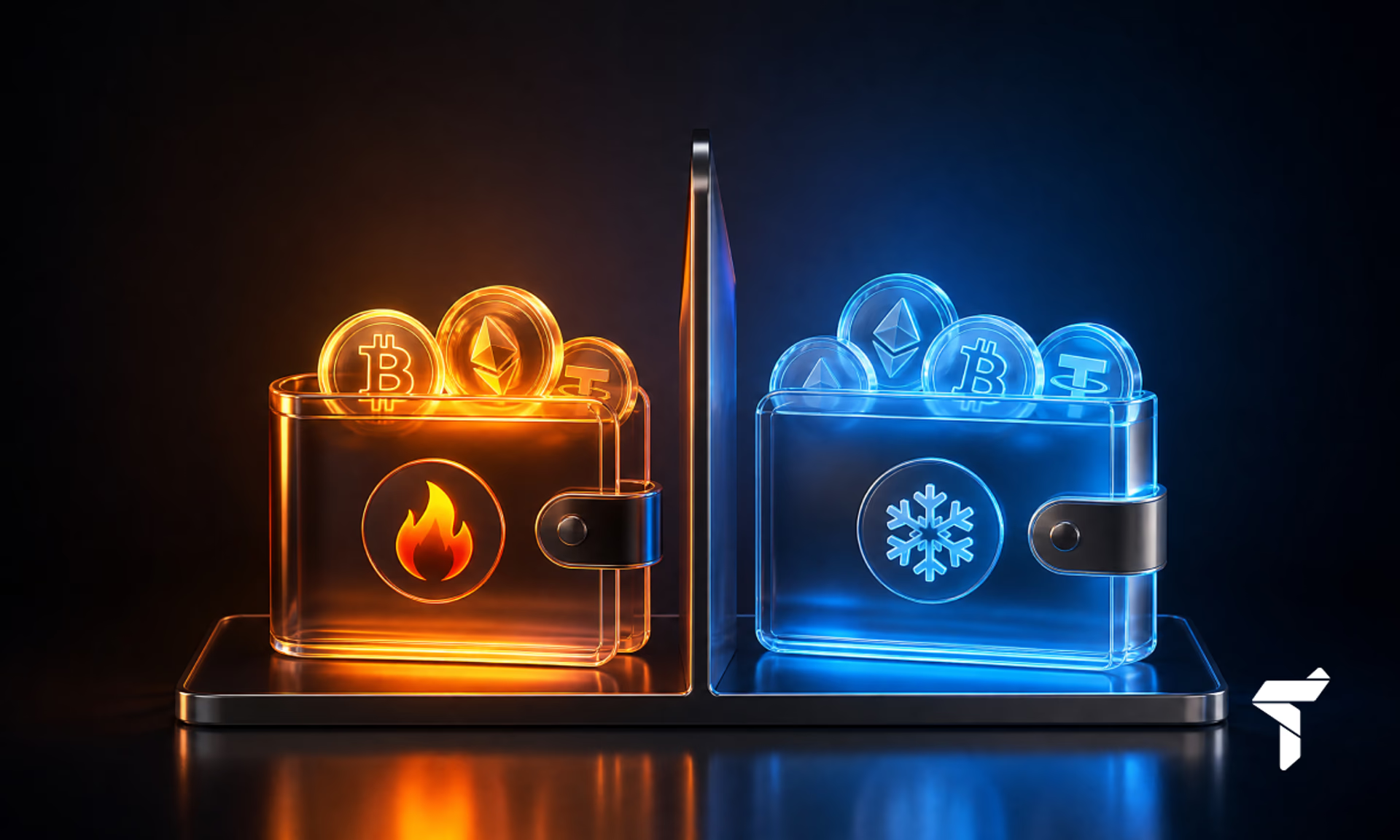
A cold wallet generally has a smaller surface for remote attacks. However, this does not mean there is no risk of losing funds — the risks simply shift from the “online” domain to physical and human factors.
Main Risks of a Hot Wallet
- phishing websites;
- fake applications;
- malicious browser extensions;
- viruses and other malware;
- programs that capture typed data (keyloggers);
- replacement of a copied wallet address in the clipboard;
- compromise of a smartphone or computer;
- theft of the recovery phrase;
- signing a malicious transaction;
- connecting to a fraudulent decentralized application;
- social engineering.
An important point: even a technically flawless wallet cannot protect a user who gives a scammer their recovery phrase or approves a dangerous transaction without reading what they are signing.
Main Risks of a Cold Wallet
- loss of the device;
- physical damage to the device;
- loss of the recovery phrase;
- incorrect backup creation;
- backup compromise, for example by storing a photograph in the cloud;
- buying a counterfeit or modified device;
- phishing during wallet recovery;
- approving a malicious transaction — yes, this can affect cold wallets too;
- unauthorized physical access to the backup.
Therefore, a cold wallet reduces the risk of remote private-key compromise, but it does not automatically protect against every type of scam, physical threat, or user error.
There is little value in absolute claims such as “a cold wallet cannot be hacked,” “a hardware wallet guarantees security,” or “a hot wallet will inevitably be hacked” — none of these statements is completely accurate. Security is not simply a property of the device; it is the result of responsible user behaviour.
Advantages and Disadvantages of Hot and Cold Wallets
Advantages of a Hot Wallet
- quick access to cryptocurrency;
- convenient for regular transfers;
- easy interaction with DeFi;
- convenient for NFTs and Web3;
- easy connection to decentralized applications;
- usually no need to purchase a separate device;
- suitable for smaller amounts and frequent use.
Disadvantages of a Hot Wallet
- larger surface for remote attacks;
- depends on the security of the smartphone, computer, or browser;
- greater phishing risk;
- risk of malware infection;
- possibility of interacting with fraudulent websites and applications;
- less suitable for long-term storage of substantial amounts.
Advantages of a Cold Wallet
- private keys are isolated from a continuously online environment;
- lower risk of remote private-key theft;
- suitable for long-term storage;
- may use a separate protected device for signing transactions;
- convenient for assets that the user does not plan to move frequently.
Disadvantages of a Cold Wallet
- less convenient for frequent transactions;
- hardware wallets must be purchased;
- the device can be lost or damaged;
- the recovery phrase must be stored correctly;
- backup mistakes can result in loss of access;
- users should have a better understanding of the recovery process;
- overall use requires a more disciplined approach to security.
Which Crypto Wallet Should You Choose?
There is no universal answer that will suit absolutely everyone — and, frankly, anyone claiming otherwise is either oversimplifying the issue or trying to sell something specific. It therefore makes sense to consider several common scenarios.
For Active Users
If you regularly make transfers, use DeFi, buy NFTs, or frequently interact with decentralized applications, a hot wallet will most likely be more convenient for these activities.
For Long-Term Storage
A cold wallet is generally more appropriate for long-term storage, significant amounts, assets that you do not plan to move regularly, or situations where the main priority is specifically to minimize exposure to remote attacks.
For Beginners
When choosing a cold wallet, beginners should focus not on branding or advertising but on practical factors: ease of setup, a clear backup process, supported cryptocurrencies and networks, the ability to verify transaction details directly on the device, clear official documentation, the manufacturer’s reputation, and the accessibility of the recovery procedure.
Can You Use a Hot Wallet and a Cold Wallet at the Same Time?
Yes, and for many users this is one of the most practical approaches available. The logic is simple: a cold wallet is used for the majority of long-term savings, while a hot wallet is used for funds intended for regular transactions.
The analogy is straightforward: a hot wallet can be compared to an everyday wallet for routine spending, while a cold wallet is more like a secure place where the majority of your savings are kept. After all, people generally do not carry all of their cash with them at once.
The practical benefits of this separation are clear:
- the majority of assets do not need to remain constantly “ready” for interaction with DeFi and Web3;
- you can deliberately limit the amount of funds kept in an internet-connected environment;
- compromise of one wallet does not necessarily mean that all assets are compromised at once;
- wallets can be separated by purpose — for example, one “for everyday use” and another “for long-term storage.”
Custodial solutions can also fit into this approach — for example, the Trustee Plus app allows users to keep part of their funds readily available for quick transactions and card payments while the majority of assets remain separately in cold storage. This is simply another way to distribute risk rather than replace one approach with another.
There is one more important point: simply transferring funds between a hot wallet and a cold wallet does not automatically make anything “safer.” What really matters is proper management of private keys and backups, not the act of moving the funds itself.
Conclusion
Hot and cold wallets differ primarily in how private keys are stored and used, not in where cryptocurrency “sits.” A hot wallet is more convenient for regular activities such as transfers, DeFi, NFTs, and Web3. A cold wallet provides stronger isolation of private keys from remote attacks and is therefore better suited to long-term storage.
For most users, a practical approach is to separate funds: money intended for regular transactions can be kept in a hot wallet, while the majority of long-term holdings remain in cold storage. This is not a promotional claim or a recommendation to buy a particular device, but rather a risk-distribution principle that works regardless of which wallets you choose. The key is to understand what each wallet is responsible for and not to rely blindly on any single tool.
FAQ
Is a Hot Wallet Safe?
A hot wallet can be sufficiently secure for everyday use, provided the user follows good security practices, keeps software up to date, and stores the recovery phrase safely. At the same time, because it operates on an internet-connected device, it has a broader surface for remote attacks compared with properly implemented cold storage. It is better to avoid absolute labels such as “safe” or “unsafe” — everything depends on the context in which the wallet is used.
When Should You Use a Cold Wallet?
A cold wallet is worth considering when cryptocurrency is being held for the long term, you do not plan to make frequent transactions, you want to reduce the risk of remote key compromise, you are storing an amount that is significant to you, and everyday convenience is not the main priority. There is little value in tying this recommendation to a specific amount in dollars or another currency — everyone has a different threshold.
What Are the Advantages and Disadvantages of Hot and Cold Wallets?
A hot wallet is more convenient, faster, and better suited to regular transactions, but it has a broader online attack surface. A cold wallet is less convenient for frequent transactions, but it isolates private keys more effectively and is better suited to long-term storage.
In both cases, securely storing the recovery phrase remains essential — without that, no technology can protect your funds.
What Is the Best Cold Wallet for Beginners?
There is no single “best model for everyone.” Beginners should evaluate ease of use, supported cryptocurrencies and networks, the backup creation method, the ability to verify transactions on the device itself, the manufacturer’s reputation, the quality of official documentation, a clear recovery procedure, and access to official purchasing channels. Ledger, Trezor, and SafePal are often mentioned among well-known hardware wallets, but these are examples for reference rather than a promotional ranking.
Can You Lose Cryptocurrency From a Hot Wallet?
Yes. This can happen if an attacker obtains the recovery phrase or private key, malware infects the device, the user signs a malicious transaction, grants excessive permissions to a fraudulent smart contract, becomes a victim of phishing, or simply loses access to the wallet without a backup. It is also worth repeating that cryptocurrency is not physically stored inside the application — the wallet manages the keys that provide access to assets on the blockchain.
Is a Hardware Wallet a Cold Wallet?
A hardware wallet is indeed commonly used as a form of cold storage because private keys are stored on a separate device and, when implemented correctly, should never leave its secure environment. However, the terms are not complete synonyms. Cold storage is a broader concept covering different ways of isolating private keys from continuous internet access, while a hardware wallet is only one — albeit one of the most common — implementations.