


The Trustee expert team conducted its own research into the self-custody wallet market in 2026 and is ready to share its key findings.
- The choice of wallet depends on your needs. The market includes cold hardware wallets, hot wallet apps, and MPC solutions without seed phrases. Experienced users often combine several types.
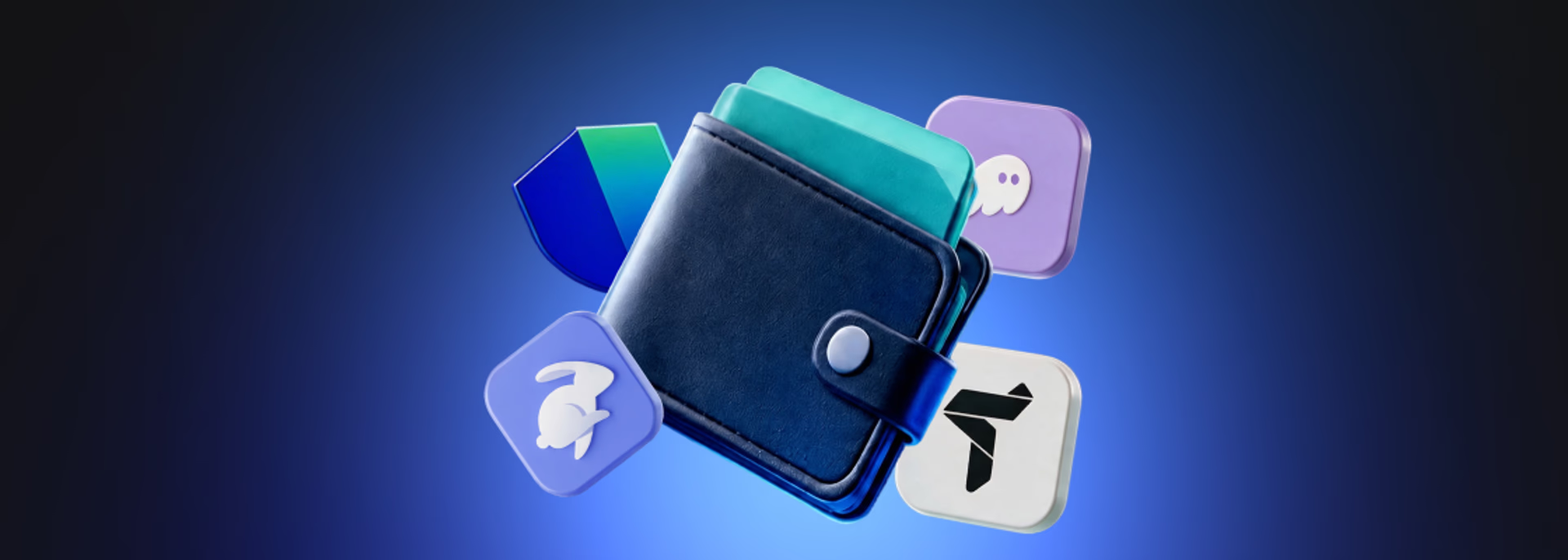
- Among the popular solutions in 2026 — Rabby for DeFi, Phantom for Solana, MetaMask for EVM networks, Trust Wallet for multichain support, Exodus for its user-friendly interface, Zengo for seedless access, and Ledger and Trezor — for cold storage.
- The main risk is the human factor: phishing websites, fake verification, and malicious token approvals remain key threats to users.


How We Compiled This Ranking
To be honest, most similar selections repeat the same set of 10-15 apps — and, as one review resource rightly notes, a significant share of these materials is written for affiliate programs rather than for real reader benefit. That is why we consciously relied not on one, but on four independent signal sources at once.
- Search results consensus in 2026 — which wallets regularly appear in editorially independent guides such as Ledger Academy, Coin Bureau, CryptoSlate, Cobo or Zengo.
- Community opinions — what people actually recommend to one another on r/CryptoCurrency, r/ethereum, r/solana and on aggregators such as AlternativeTo, where real users vote, not advertisers.
- Ratings in the App Store and Google Play, as well as Trustpilot reviews — this is where real complaints usually surface, the ones that do not make it into promotional materials.
- Independent security research: chip certification level, source code openness, audit history and documented attack cases.
Where we cite a specific figure or fact from a particular source, we state this directly in the text. But we must honestly warn: a significant part of the statistics in this topic — the number of users, store ratings, the amount of funds lost — becomes outdated quickly and differs from source to source, so these figures should be treated as a reference point, not as precise truth, and checked separately when necessary.
Let Us Clarify the Terms
If you were looking for an answer to the question “what is a self-custody wallet” or “how is a decentralized wallet different from a non-custodial one”, here is the good news: the difference is mostly purely terminological.
- A non-custodial wallet is one where you control the private keys used to sign transactions.
- A self-custody wallet is the same idea, only expressed through ownership: your keys — your crypto, period.
- A decentralized wallet usually means the same thing: you personally sign transactions, without an intermediary in the form of an exchange or custodial service.
Why does this matter at all? Because with a custodial account, a platform technical failure, a freeze or even a company bankruptcy can cut you off from your own money. That is why the phrase “not your keys, not your coins” became one of the main principles in crypto after the stories of FTX, Celsius and other similar collapses. Self-custody removes this counterparty risk, but instead shifts all responsibility to you. Lose your keys — and no support team, no matter how polite, will be able to help.
Independent analytical materials from 2026 — Cobo, CryptoSlate and several specialized blogs — more or less agree on one thing: instead of asking “which wallet is the best overall”, you should ask yourself “which level of protection fits a specific amount”. Here is how this logic looks in practice.
|
Level |
What it is |
Strength |
Weakness |
Use case |
|
Hardware (cold) |
Keys are stored offline, on a separate device (Ledger, Trezor) |
Maximum security — keys never touch the internet |
Less convenient for daily use, initial device cost |
Long-term storage of large amounts |
|
Software (hot) |
An app or browser extension (MetaMask, Rabby, Phantom) |
Fast, free, deep integration with DeFi and dApps |
Keys are on a device connected to the internet |
Daily transactions, DeFi, NFTs |
|
MPC / seedless |
The key is split into shares, with no single seed phrase existing (Zengo) |
Removes the seed phrase as a single point of failure |
A newer model, with some solutions keeping a key share on the provider’s side |
Self-custody without the fear of losing a phrase |
The best setup suggested by specialized authors, including Coin Bureau, is not “one wallet” at all, but a combination of two levels that work together: a hardware signer handles key storage, while a software interface — MetaMask or Rabby — handles swaps, staking and connections to decentralized applications. They do not compete — they complement each other.
Best Hot (Software) Wallets — Where the Community Actually Lives

Rabby — the favorite for those seriously into DeFi
Rabby, developed by the DeBank team, is regularly named in 2026 as one of the safest EVM wallets and almost the strongest competitor to MetaMask in the field of pure Ethereum experience. The key feature here is transaction simulation before signing: the wallet shows which exact tokens will move and which permissions you are granting before you press “confirm”. In a year when malicious approvals are the main cause of wallet drains, this hits the most real risk directly, rather than simply looking good in screenshots.
The wallet is free, open-source (MIT license) and supports more than 100 networks with automatic switching between them. On AlternativeTo, it almost always appears as the number one alternative to other EVM wallets.
MetaMask — the standard everyone else is still measured against
MetaMask remains the default Web3 wallet and the most widely integrated one in the DeFi ecosystem. By 2026, it had moved far beyond EVM — adding support for Bitcoin and Solana, as well as deep integration with Ledger and Trezor. The community’s constant complaint: the interface still feels overloaded for beginners, while the standard transaction signing screen gives fewer protective hints than, say, the same Rabby.
Phantom — the Solana leader that grew into a multichain wallet
Phantom holds a confident lead in the Solana ecosystem and, according to some estimates, has grown its audience to more than seven million users thanks to a simple and pleasant interface. But this is not certain; the figure should be checked before publication. It now also supports Ethereum, Bitcoin and Polygon, and also offers MPC login without a seed phrase.
Trust Wallet — the widest network coverage on mobile
Trust Wallet belongs to Binance, but is managed as a separate product. It is a mass-market mobile choice: according to the service itself, more than 200 million users and support for more than 100 blockchains without mandatory account registration. The figures come from the provider itself, so current data should be checked separately. Store ratings are high — approximately 4.7 in the App Store and 4.6 in Google Play based on millions of reviews.
There is a nuance worth mentioning honestly: the Trustpilot rating is significantly lower than the store ratings. But if you look more closely at the reviews themselves, the predominant share of complaints there concerns losses due to phishing schemes and users’ own mistakes, which are typical of any self-custody wallet, rather than a technical failure of the service as such.
Exodus — the most polished visual experience
Exodus is consistently mentioned as the most neatly designed wallet for portfolio management from a visual standpoint. It is available on desktop, mobile and as a browser extension. Interesting fact: it is one of the few wallets whose company is publicly traded on the NYSE.
Coinbase Wallet — a soft entry into self-custody for beginners
It is important not to confuse it with the custodial account of the Coinbase exchange itself: Coinbase Wallet is a separate, truly non-custodial app. It is often recommended as a first step into self-custody for people who are already used to the exchange interface and do not want to change their habits abruptly.
Best Hardware (Cold) Wallets
Ledger — the default choice in 2026 for cold storage
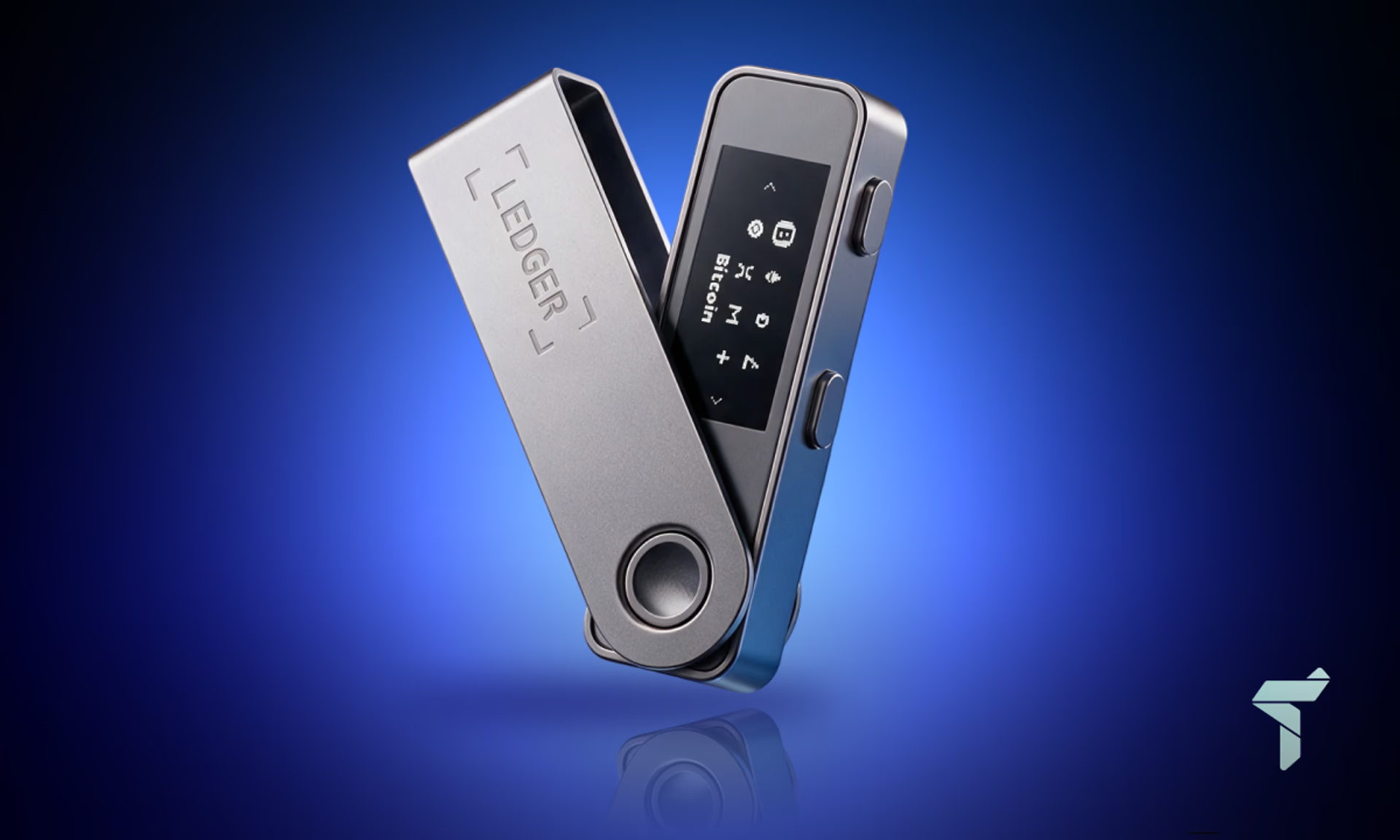
Ledger devices, such as Ledger Flex, remain the most frequently mentioned hardware solution in independent comparisons. At their core is a certified secure chip rated CC EAL6+, tested against physical data extraction, side-channel attacks and fault-injection. It is telling that the official Ledger Academy states that there has not been a single confirmed case of private keys being extracted directly from a Ledger or Trezor device — that is precisely why scammers long ago switched to deceiving people rather than hacking hardware.
Trezor — an open-source veteran
Trezor, the Safe 5 generation, combines offline key storage with the Trezor Suite app and broad compatibility with third-party wallets — MetaMask, Exodus, Electrum. The open-source ideology attracts those who want to verify for themselves how everything works rather than simply trusting the manufacturer’s word. Concerns about physical key extraction that applied to older models have already been addressed in the Safe series.
SafePal — a universal safe with a mobile character
This hardware wallet appeared in 2018 with the support of Binance Labs. SafePal combines hardware storage of private keys with a mobile app and support for a large number of blockchain networks and digital assets. The device operates isolated from the internet, and when signing transactions, it uses QR codes, so the private key never leaves the hardware wallet. Through the SafePal app, you can manage your portfolio, swap assets and interact with Web3 services. It is an interesting option for those who need a balance between hardware wallet security and the convenience of mobile management.
New-Generation Seedless Wallets (Cypherock, Ryder)
A separate niche of hardware wallets removes the single seed phrase entirely — through card cloning, Shamir’s Secret Sharing scheme or key sharding. The motivation here is fairly down-to-earth: according to researchers’ estimates, millions of BTC have been lost forever specifically because of forgotten or destroyed seed phrases — and this figure is likely higher than everything ever stolen through exchange hacks.
Cypherock
Cypherock (Cypherock X1) is a hardware cold wallet focused on decentralized key storage and asset inheritance. Instead of writing down a seed phrase, your private key is split into 5 encrypted parts. They are stored on the main device — the X1 Vault with a screen — and on 4 NFC cards that look like bank cards.
Ryder
Ryder (Ryder One) is an ultra-compact hardware wallet created for the fastest possible daily use based on the Tap-to-Sign principle — tap and sign. The main feature is TapSafe & Seedless: the device is shaped like a credit card without a battery or wires. It is activated autonomously via NFC when tapped against a smartphone.
MPC Wallets: Self-Custody Without the Fear of Losing a Phrase
Zengo — the rare case where there really is no seed phrase
Zengo uses Multi-Party Computation (MPC) technology, which splits the key into shares in such a way that no single seed phrase exists in principle, while access recovery happens through biometrics. It is the most frequently mentioned option for people who want true self-custody but are terrified of losing or incorrectly writing down a classic 12-24 word phrase somewhere.
The compromise compared with cold storage is obvious: there is no chip fully isolated from the network here, so it is well suited for an active balance, but worse than a hardware wallet for long-term “vault” storage.
The New Wave: Wallets With Gas Abstraction
One of the most discussed inconveniences of self-custody sounds down-to-earth, but affects literally everyone: you have to keep a separate native token — ETH, POL, BNB, SOL — in each network just to pay the transaction fee.
A new generation of wallets is trying to solve this problem through account abstraction and sponsored fees.
Ambire
Ambire is an open-source non-custodial wallet that implements smart account features, the EIP-7702 standard, sponsored transactions and cross-chain gas payment without manually bridging funds between networks.
Simple
Simple is a stablecoin-oriented self-custody wallet that takes gas payments on itself: the user focuses on the transfer itself, not on what exactly should be used to pay the fee in a specific network.
An honest caution: this category exchanges part of a time-tested track record for convenience. Behind Ledger, MetaMask or Trust Wallet stand years of operation and hundreds of millions of users; gas-abstraction solutions are significantly younger, so they should be evaluated specifically by security audits, code openness and how exactly fee sponsorship is structured, not only by attractive UX.
Quick Choice: Which Wallet Fits Which Profile
- Absolute beginner, phone only: Trust Wallet or Coinbase Wallet — simple, multichain, with decent store ratings.
- Active DeFi user on EVM: Rabby — transaction simulation here is not a whim, but real protection.
- If your priority is the Solana ecosystem: Phantom.
- Design and portfolio tracking matter: Exodus.
- A seed phrase means fear and panic: Zengo (MPC) or seedless hardware solutions such as Cypherock or Ryder.
- Long-term storage of large amounts: Ledger, Trezor or SafePal — ideally paired with Rabby or MetaMask as a daily interface.
- Tired of holding gas tokens in every network: a wallet with gas abstraction, such as Ambire or Simple.
- Bitcoin maximalism: Sparrow, Electrum or Coldcard for the deepest level of self-custody.
As one specialized resource accurately summarizes, for most people the correct answer is not one wallet, but two: a hot one for daily tasks and a hardware one for savings they would hate to lose.
Security Practices That Truly Matter in 2026
Self-custody shifts all responsibility to you — and this is not a point that can be negotiated or skipped.
Here are several key tips that will make your security much stronger if followed:
- Store your seed phrase offline. Write it down by hand or engrave it on metal for fire and water resistance — and never keep it as a screenshot, a cloud note or an email.
- Never enter your seed phrase on any website or in any third-party app. No legitimate wallet and no real support team will ever ask for it — period.
- Check the transaction on the hardware device screen and use simulation where available: interfaces such as Rabby directly show which tokens are moving before signing.
- Regularly revoke old approvals. A single forgotten malicious approval can drain a wallet even a year after you granted it.
- Separate hot and cold balances. Keep only an “expense” amount in a hot wallet, and move savings to a hardware signer.
- Verify addresses and contracts independently: check the first and last characters of an address, and take a token contract address only from an official source.
- Lock your device with biometrics or a PIN code and update firmware and apps on time.
- Ignore any “support” that messages you first in private messages. No phone number can cancel a self-custody transaction that has already been signed.
- Test wallet recovery once on a spare device — before you actually need it.
Four Questions That Will Help You Choose Your Wallet
- How much exactly are you protecting? A small active amount — a software wallet. A large amount for the long term — hardware or MPC.
- Which networks do you use most often? Mostly EVM — Rabby or MetaMask. Solana — Phantom. Everything at once and from a phone — Trust Wallet.
- What annoys or scares you the most? Hate seed phrases — look at Zengo or hardware solutions without a phrase. Tired of holding gas tokens in every network — look for a gas-abstraction wallet.
- How often do you sign transactions? If often, choose a wallet with simulation and phishing alerts, such as Rabby, not the one that simply supports more networks.
Instead of a Conclusion
In 2026, there is already a fairly mature answer to the question “which non-custodial wallet is best”: layer your storage. A hardware signer — Ledger, Trezor or SafePal — for the role of a vault. A software wallet with a simulation function — Rabby or MetaMask/Phantom/Trust Wallet, depending on your ecosystem — for daily operations. And if your main pain point is seed phrases or juggling gas tokens across different networks, it is worth taking a closer look at an MPC wallet such as Zengo or gas-abstraction solutions such as Ambire or Simple.
And the main thing to take away from all this material: the wallet matters less than your own discipline. In a year when attackers target people, not chips, habits are the real layer of protection that no device, even the most expensive one, can replace.
FAQ — Frequently Asked Questions
What is the best wallet for self-custody?
There is no single winner. For maximum security — a hardware wallet, Ledger or Trezor. For daily DeFi work — Rabby or MetaMask. For simplicity without a seed phrase — Zengo. The best wallet for you personally is the one that matches the amount you hold and how often you sign transactions. Most experienced users keep both a hardware wallet for savings and a software wallet for daily tasks.
How is a decentralized wallet different from a non-custodial one?
Essentially, it is not — they are synonyms. Among software solutions, MetaMask and Rabby dominate the EVM/DeFi segment, Phantom leads in Solana, and Trust Wallet provides the widest network coverage on mobile — and all of them are fully non-custodial.
Which wallet is best for a beginner?
Trust Wallet and Coinbase Wallet are considered the most understandable non-custodial apps for a first introduction to self-custody. If the main barrier is the seed phrase itself, it is worth looking at Zengo.
Are non-custodial wallets safer than exchanges?
They remove counterparty risk — no exchange can freeze or accidentally lose your funds because it simply does not have them. But instead, you take full responsibility for security, and access recovery in case of lost keys does not exist in principle. So “safer” here depends entirely on your own habits and discipline.
Is a wallet without a seed phrase true self-custody?
It can be — and this depends not on the key storage technology, but on whether the provider can independently, without you, access the funds, move them or freeze them. MPC, Shamir and passkey wallets can absolutely be true self-custody if no key share ever fully falls under the company’s sole control.