



P2P earning is one of the most popular ways to generate income from cryptocurrency through direct transactions between users: you choose the counterparty, exchange rate, limits and payment method yourself, while the platform helps protect the deal with escrow and dispute resolution.
In this article, we will explain how to make money on an exchange through P2P trading: what it is, what strategies exist, which platforms are suitable for beginners, and what risks you should take into account.
Key Takeaways
- P2P crypto trading allows users to buy and sell digital assets directly with one another, while profit is usually formed from the spread between the buying and selling price.
- The main safety tool in P2P trading is escrow: cryptocurrency is temporarily locked by the platform and released to the buyer only after payment is confirmed.
- The most common beginner-friendly direction is trading stablecoins, especially USDT and USDC, against local fiat currencies.
- P2P earning is not guaranteed income: profitability depends on liquidity, payment method fees, reaction speed, limits, demand, market volatility and risk management.
- To trade safely, check the counterparty’s rating, never release crypto before the money actually arrives, and keep communication inside the P2P platform.


What are P2P exchanges and why are they popular?
P2P exchanges are platforms that allow users to buy and sell cryptocurrency directly to one another, without the exchange acting as the second party to the transaction. Instead of exchanging assets with the exchange itself, you make a deal with another individual — the platform acts as a security layer, fixes the transaction terms and handles escrow operations.
In addition, earning on an exchange through P2P opens up the opportunity to make a profit not only from exchange rate differences, but also from fast operations in the local market with minimal fees. Stablecoins such as USDT and USDC are especially common in P2P crypto trading because their value is tied to the US dollar and they are convenient for settlements between crypto and fiat.
Main principles of earning on P2P exchanges
You earn on the difference between cryptocurrency buying and selling rates. For example, you buy USDT cheaper from a seller with a low rate, and then sell it for more — already as a seller with a higher rate. This is a simple but effective mechanism for how to earn on P2P without deep trading knowledge.
The market is constantly changing, so you need to focus not only on the rate, but also on demand. For example, in regional fiat currencies, you can find a higher margin than in dollars or euros. For beginners, this is a good opportunity to understand how to make money on P2P by experimenting with different exchange directions.
In P2P trading, profit often depends on how quickly you react to market changes. Therefore, the ability to monitor prices, evaluate offers in real time and immediately place profitable orders becomes essential.
Choosing a reliable P2P platform
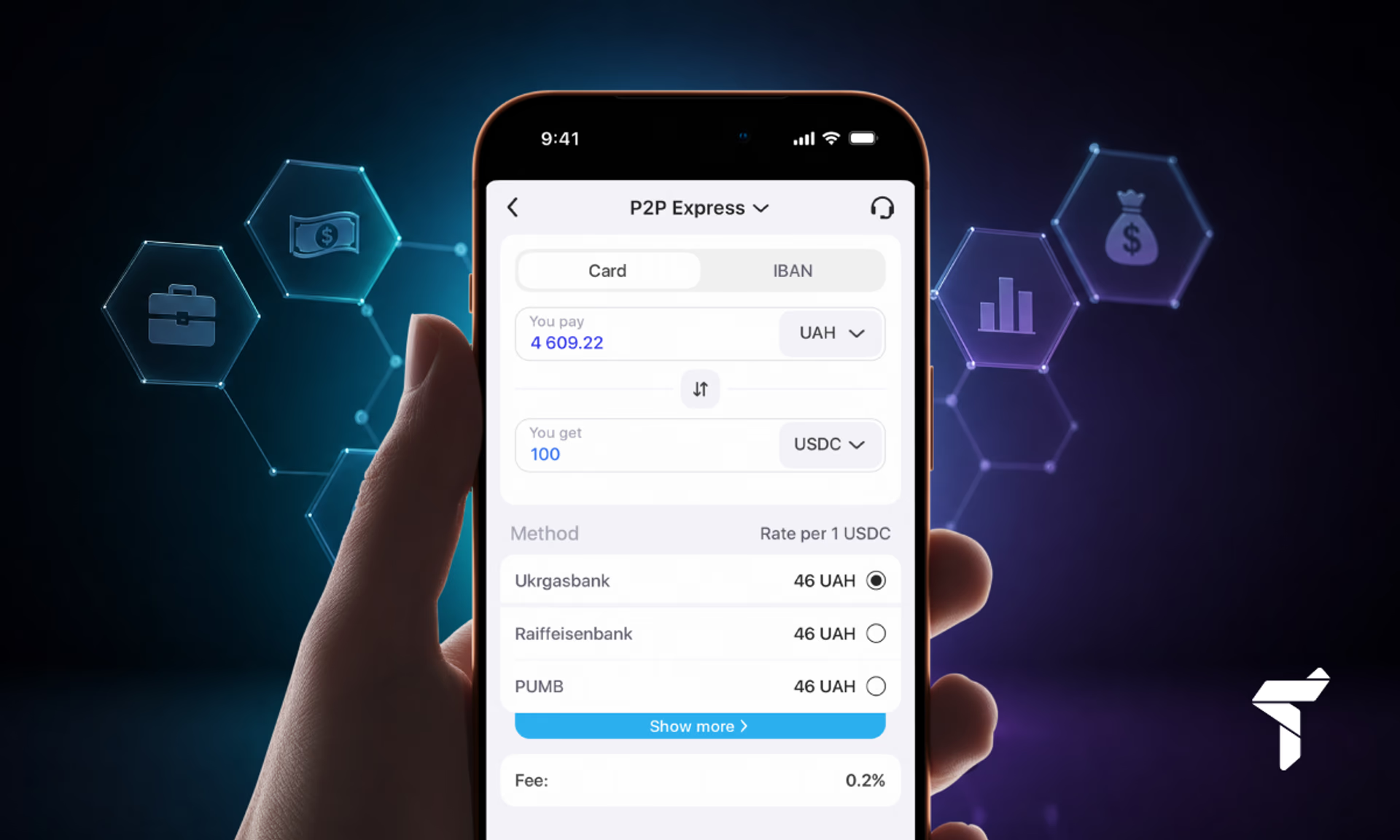
Before you start P2P trading, you should choose a platform you can trust. A reliable crypto P2P exchange should provide transaction protection, user support, a convenient interface, escrow protection, a rating system and a clear appeal mechanism for disputed transactions.
One example is Smart P2P in Trustee Plus, a crypto service that supports P2P earning and allows users to buy and sell cryptocurrency without unnecessary intermediaries. It has a built-in P2P marketplace, quick offer selection, convenient payment methods and a mechanism for resolving disputed situations.
Registration and verification on the exchange
To start earning on cryptocurrency exchange, you need to create an account and complete verification. This is a standard procedure: identity confirmation, document upload, and sometimes a selfie. Verification helps reduce the risk of fraud, increases trust between transaction participants and can provide access to more payment methods.
Studying trading pairs and choosing promising cryptocurrencies
Popular trading pairs include USDT/UAH, BTC/USDT and ETH/UAH. It is worth paying attention to liquidity, volatility and demand levels in a specific region. This makes it easier to find buyers or sellers quickly at a favorable price.
Market analysis and price forecasting
To understand how to make money on an exchange, you need to learn how to read the market. This does not always require deep analysis: basic skills are enough — comparing rates across different platforms, tracking news, studying charts and evaluating the spread between the buying and selling price.
Risk management and portfolio diversification
How can you earn steadily on an exchange? The answer lies in proper risk management. Divide your capital across several trades, do not invest everything in one asset, and do not ignore market changes. Also consider payment method limits, possible bank transfer delays and cryptocurrency volatility.
Placing buy and sell orders for cryptocurrencies
The next stage is active participation in trading. You set the rate, volume and payment method yourself. This is where real P2P earning begins: you buy cheaper and sell for more.
Monitoring and managing deals
After creating an order, it is important to track the status of the deal: whether the payment has been confirmed, whether the funds have arrived, and whether there are any delays. A quick response to messages, communication with counterparties and compliance with platform rules increase your rating and improve your chances of future profitable deals.
Withdrawing funds
Once you have made a profit, the final stage begins — withdrawing money. Beginner-friendly crypto exchanges usually offer simple options: to a bank card, through payment systems or even in cash in certain countries. The availability of a specific withdrawal method depends on the platform, region, currency and rules of the selected payment method.
Strategies for earning on P2P exchanges

There are several approaches to making money on P2P, depending on the trader’s experience level, starting capital and goals.
Arbitrage: how to earn on exchange rate differences
One of the simplest P2P trading strategies is arbitrage. The idea is to use the difference in rates between different exchanges, payment methods or regions. For example, on one platform you buy USDT at a lower rate, and on another you sell it for more.
Speculation: buy cheaper — sell higher
You place an order to buy cryptocurrency at a favorable rate, wait for it to be filled, and then resell it at a higher price — either on the same platform or in another region. It is important to track changes in demand, the popularity of specific assets and set up quick notifications about new deals.
Investment strategies: long-term cryptocurrency earnings
If you are not ready to monitor the market constantly, you can choose a calmer way to earn on cryptocurrency — invest in promising coins when the price falls and sell during a growth phase.
For example, you can buy BTC or ETH on a P2P exchange when the market is in the “red zone” and hold the asset for several months.
P2P trading risks and how to reduce them
Before you start earning on P2P, it is important to understand not only the benefits, but also the possible risks. Fraud tactics can include fake payment screenshots, social engineering, phishing links, pressure in chat, third-party payments and attempts to move the transaction outside the official platform.
To reduce risks, follow basic safety rules:
- Do not release cryptocurrency before the money actually arrives: check your balance in the bank app or payment system, not only messages or screenshots from the counterparty.
- Do not move to messengers: keep all deal terms, communication and evidence inside the P2P platform so that support can review the case if a dispute occurs.
- Check the counterparty’s rating and history: pay attention to the number of completed trades, success rate and reviews from other users.
- Consider bank and payment limits: frequent similar transfers may trigger additional checks by a payment service or bank.
- Avoid suspicious payment schemes: avoid third-party transfers, strange payment descriptions and offers with an unrealistically high exchange rate.
Reliability and reputation of P2P platforms
In the cryptocurrency sector, where limited regulation can lead to fraud, it is important to focus on proven services with a good reputation.
One such platform is Trustee Plus — a convenient mobile app with support for P2P deals, combining security, a simple interface and high transaction processing speed.
Trading volume and liquidity of trading pairs
On a P2P exchange, liquidity is the ability to buy or sell cryptocurrency quickly without significant price loss. For stable P2P earning, it is important that popular pairs (USDT/UAH, BTC/USDT) have enough active offers and a small spread between the buying and selling price. The higher the activity of users on the platform, the faster and more profitably deals are closed.
Ease of use of the interface
For beginners, it is especially important that a P2P platform is easy to use. In complex systems, it is easy to make a mistake, which can lead to financial losses. That is why Trustee Plus shows that earning can be as comfortable as possible.
The interface allows you to:
- quickly view available offers;
- choose a payment method and currency;
- filter deals by volume and seller rating;
- create your own orders in just a few clicks.
Availability of educational materials and user support
Most popular P2P exchanges offer sections with step-by-step guides, analytical articles, video tutorials on YouTube and interactive quizzes to test knowledge. Some platforms have online academies with courses for beginners, separate sections on risks, order types, verification and safe work with crypto assets.
User reviews and ratings
Before registering on a platform, it is worth checking its reputation using open sources. It is best to focus on reviews in the App Store, Google Play, crypto forums on Reddit, as well as specialized rating websites such as Trustpilot or CryptoCompare.
Conclusion
P2P earning opens up broad opportunities for those who want to start working with cryptocurrency without significant investment.
The optimal approach for a beginner is to start with small amounts, choose liquid pairs, carefully check counterparties and gradually test different strategies: arbitrage, quick spread-based trades or long-term asset purchases through P2P.
FAQ
What is P2P crypto trading in simple terms?
P2P crypto trading is the buying and selling of digital assets directly between users. The platform helps find a counterparty, fixes the deal terms and usually uses escrow to protect both the buyer and the seller.
Can you make money with P2P crypto trading?
Yes, you can make money with P2P crypto trading, but income is not guaranteed. The main profit usually comes from the difference between the buying and selling rate, as well as from quick reaction to demand, liquidity and market changes.
How does P2P crypto arbitrage work?
P2P crypto arbitrage means finding rate differences between platforms, regions, payment methods or currency pairs. A trader buys cryptocurrency cheaper and sells it for more, while taking into account fees, limits, payment speed and transaction risks.
How much money do you need to start P2P trading?
You can start with a small amount, but the size of your profit depends on capital, the number of trades and the size of the spread. Beginners should test P2P trading with minimal volumes and increase the amount only after they understand the market mechanics.
What are the main risks of P2P crypto trading?
The main risks of P2P trading include fraud, fake payment confirmations, payment reversals, transfer delays, blocked transactions due to disputes, price volatility and violation of platform rules. Escrow, counterparty checks and trading only inside the platform help reduce these risks.
How do you choose a reliable P2P platform?
A reliable P2P platform should have escrow protection, user verification, a clear interface, active liquidity, ratings, support and an appeal mechanism. It is also worth checking reviews, fee conditions, available payment methods and transaction limits.